
St. Louis City Parole and Probation
Parole follows a Missouri prison term. The Missouri Parole Board may authorize release before the maximum sentence expires, while the Department of Corrections supervises the person in the community. Conditional release is also a supervised part of a prison sentence, but its basis comes from the sentence structure set by law. Probation begins with a court disposition. It permits a person to live in the community under set terms and can start without any release from a state prison. A brief stay at the St. Louis City Justice Center may occur before probation, but that stay does not turn probation into parole.
The source of authority is the key. A former CJC detainee appears in Missouri DOC supervision records only when the state agency has jurisdiction over that probation, parole, or conditional-release matter. Release on a City bond means that charges may remain pending. It does not mean supervision began. Likewise, dismissal of a City charge does not prove that another supervision case exists or ended. Compare the active DOC record with the St. Louis City matter in Missouri Case.net.
| Supervision type | How it begins | Best verification |
|---|---|---|
| Parole | Parole Board release from a Missouri prison before the maximum sentence end | Active DOC status, field assignment, court cause number, and assigned officer |
| Conditional release | Statutory supervised portion of a Missouri prison sentence | DOC sentence record, current field assignment, and court judgment |
| Probation | Court order allowing community supervision under conditions | Case.net disposition plus the active DOC supervision record |
| Discharge | Completion or lawful end of the identified supervision term | Field-office confirmation, court docket, and any completion record |
- Parole
- Community supervision after release from prison under Parole Board authority.
- Probation
- Community supervision ordered by a court, sometimes without a prison term.
- Conditional release
- A supervised part of a Missouri prison sentence set through state law.
- Absconder
- A person alleged to have stopped reporting or left supervision without approval. The label does not prove current jail custody.
Verify St. Louis City Post-Release Supervision
Start with the Missouri DOC Offender Search. It covers active Missouri offenders, including people on parole and probation, but it excludes discharged offenders. Use the DOC number when known. If searching by name, compare the result with known birth information, the offense or cause number, sentence county, status, assigned location, and the record’s as-of time. A field-office assignment points to community supervision rather than prison confinement. A blank search cannot confirm that the person was never supervised because completed cases may no longer appear.
St. Louis City is its own jurisdiction. Match the DOC cause number and sentence county to the Twenty-Second Judicial Circuit or City municipal case in Case.net. Municipal matters have appeared in the statewide portal since January 2025. Court entries show the disposition and sentence, while DOC shows the active supervision assignment. Those sources answer different parts of the question.
- Search the DOC number or the person’s full name in the state offender search.
- Open the likely result and compare identity, cause number, sentence county, status, and assigned location.
- Open the matching St. Louis City case in Case.net and confirm the judgment or probation order.
- Use the DOC Probation and Parole directory to identify the office tied to the assignment or residence.
- Ask the assigned field officer whether the case is active, completed, revoked, or transferred.
- For completed supervision, reconcile the field-office response with the latest court entry.
A former City detainee may have transferred to Missouri DOC instead of going home. Departure from CJC is not proof of community release. If the case shows a prison commitment, the state record controls the custody and supervision path. The broader St. Louis City released-inmate search explains how a City release record and court docket confirm the earlier CJC departure.
Note: DOC search results cover active supervision, while a no-result may reflect discharge and must be checked against the court and field office.
St. Louis City Supervision Office Verification
The assigned field office is more than a directory entry. Missouri DOC directs a specific offender-status question to the caseworker or probation and parole field officer. The statewide directory helps locate the St. Louis district shown in the offender record or associated with the approved residence. Office assignments can change after a move or case transfer, so an old address should not be treated as current.
The DOC contact page is the fallback when the automated record is not enough. An Offender Inquiry should include the correctly spelled full name, DOC number, date of birth or another sound identifier, and one exact question. DOC says a general inquiry usually receives an email response within 24 regular business hours, but it also states that specific status questions belong with the field officer. Keep those routes separate.
Missouri Probation and Parole
Office route: Use the official district directory and the assigned location in the DOC result.
Specific status: Assigned probation and parole field officer.
General fallback: Missouri DOC Offender Inquiry.
Directory: Probation and Parole offices
The directory page shown in the official capture is the right starting point for a current office. It is not proof that one named person is assigned there.
Review the Missouri DOC supervision-office directory before using the contact details displayed in a search result.
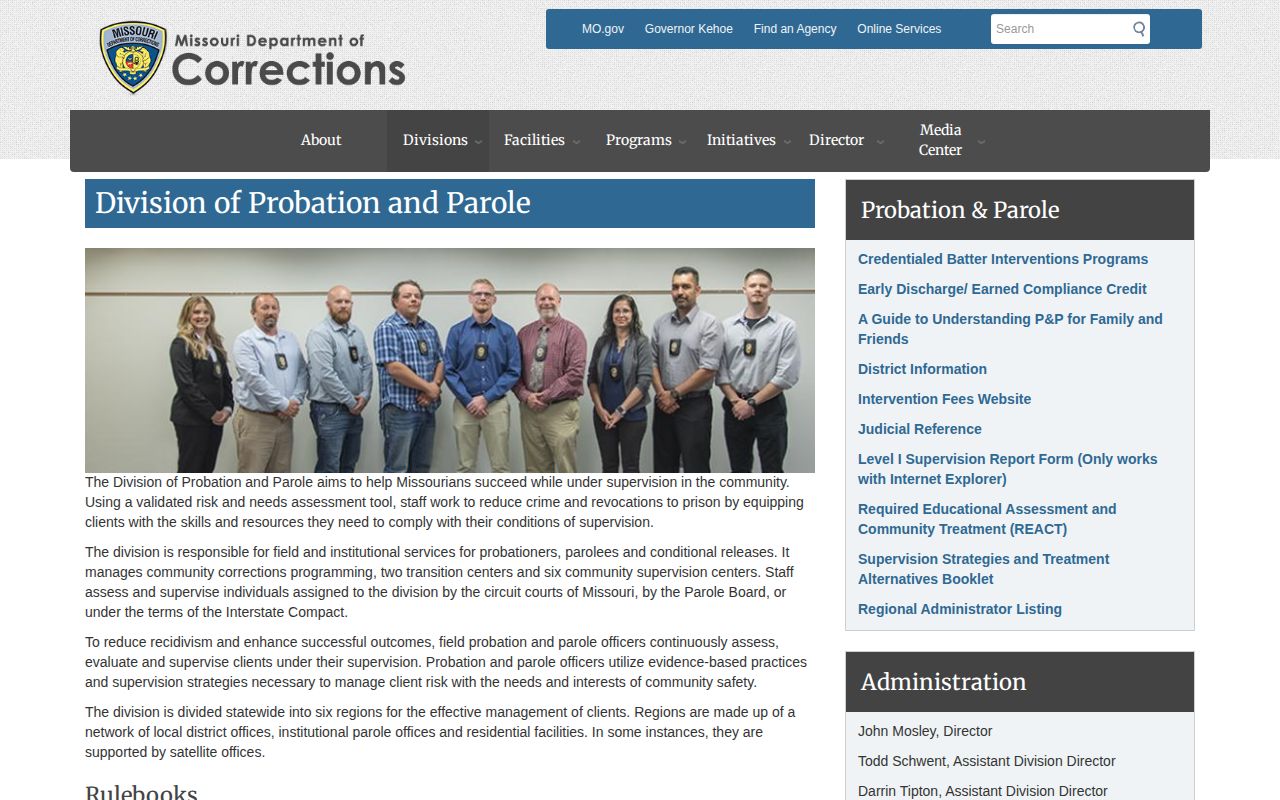
The directory supports the handoff from an online status check to the field office that can confirm the current assignment.
St. Louis City Parole Hearing Status
A parole hearing is not a release event. The Missouri Parole Board schedules eligibility hearings based on sentence length and applies the law and Board rules to each case. The Board may consider the offense, conduct in the institution, adjustment, completed programs, and programs still needed. A result can include a future release date or another hearing later. Until custody actually ends, a hearing or decision should not be described as physical release.
The official hearing-process explanation says a Board decision normally takes about eight to twelve weeks after the hearing. That range concerns decision time, not the day a person leaves prison. No stable public search for individualized recent parole decisions was verified. Do not infer a grant or denial from a missing online result. A registered victim may receive an official notice, and a later change may appear in the DOC status.
Hearing status is not release status. A future date can remain subject to legal conditions, another hold, sentence rules, or later Board action. Confirm completed release with DOC.
St. Louis City Supervision Violations
Supervision conditions are the rules a person must follow while a case remains active. The exact terms come from the court, Parole Board, DOC, and field officer. A claimed violation can lead to an investigation, a warrant, a hearing, revocation, or some other response allowed by law and policy. The presence of an allegation does not establish its outcome. Read the current docket and ask the assigned office.
An absconder status means the agency alleges that the person stopped reporting or left supervision without approval. It does not show where the person is now. A warrant also does not prove that the person has been booked into the St. Louis City Justice Center. Verify a warrant with the issuing court or agency, then use the correct current-custody locator for the jail or prison involved. If a person is arrested in another jurisdiction, the St. Louis field record may not identify the new facility at once.
Notification systems serve a different role. Current Missouri MOVANS can send custody or court-event notices when the relevant source participates, but it does not replace the DOC field record. A supervision change may need direct confirmation from the officer. That distinction helps avoid reading a custody alert as a full statement of probation or parole status.
Note: An absconder or warrant notation does not establish present confinement, so verify both the issuing action and the current custodian.
When St. Louis City Supervision Ends
Discharge means the identified supervision obligation has ended. It is not the same as parole, conditional release, transfer, or an inactive-looking web result. Missouri DOC’s public offender search expressly excludes discharged offenders, so a record can vanish after completion. The court docket, DOC records, and field-office response then carry more weight than the active search screen.
Eligible people may earn compliance credits under RSMo 217.703. Those credits can shorten a qualifying probation, parole, or conditional-release term when the person complies. They affect community supervision time. They do not rewrite the day the person physically left CJC. Eligibility, exclusions, and the current credit calculation must be confirmed under the statute and DOC policy.
Ask a precise closing question: is the case active, completed, revoked, or transferred? Then compare the answer with the St. Louis City court record. Revocation may return a person to custody. Transfer may move supervision to another office or state. Completion ends the term at issue, but it does not by itself describe unrelated cases. Missouri’s records law can also limit public details where a record is sealed, closed, or expunged.
St. Louis City Post-Release Property
Leaving supervision and retrieving property are separate tasks. St. Louis City maintains an official former-inmate property-return service, and the CJC Property Unit is listed on the Corrections contacts page. The published main number is (314) 621-5848, with Property Unit extensions 2233 and 2270. Call first because the City has changed some service-page paths.
Property pickup does not prove parole, probation, discharge, or the exact release time. It also is not a request for a release record. A person seeking proof of a completed CJC stay should ask Corrections Data Entry about the released-person Letter of Incarceration. Someone trying to resolve state supervision should contact the assigned field officer instead. Keeping those requests distinct directs each question to the unit that created the relevant record.
Public Record Search
Sponsored Results