
St. Louis City Release Paths
The St. Louis City Justice Center, or CJC, is the independent city’s only active local Corrections facility. It holds pretrial and sentenced people, but it is a local jail rather than a Missouri state prison. A person’s departure closes a City custody episode. It does not always mean the person went home.
A detainee may leave after bond, a court-ordered pretrial release, dismissal, time served, or expiration of a local sentence. Corrections may instead deliver the person to Missouri DOC, another jurisdiction with a warrant, federal authorities, or another receiving agency. Each path produces a different next place to search. The City release transaction, particularly its release type, authority, and destination fields, is what separates community release from custodial transfer.
| Departure type | Meaning | Next verification source |
|---|---|---|
| Bond or court release | The City may release the person while the case continues. | Corrections release transaction and Case.net |
| Time served or local sentence end | The local custodial term has been credited or completed. | Corrections record and judgment |
| Dismissal-related release | The prosecution changed or ended, subject to any other holds. | Case.net and completed jail release time |
| Transfer to Missouri DOC | City custody ended, but state custody began. | Missouri DOC and court judgment |
| Transfer to another authority | The person remained in custody elsewhere. | Named receiving agency or jurisdiction |
Inside a St. Louis City Release Record
A useful St. Louis City release record joins an admission to a departure. No single public screen promises every field, and the City locator does not advertise a release archive. A focused request should seek the existing transaction and ask for the code definition when an agency uses an abbreviated disposition. The associated booking photograph is a separate record item and can receive different disclosure treatment.
| Booked name and identifiers | Connect the record to the correct person; a master or booking number is stronger than a name alone. |
|---|---|
| Admission date and time | Marks the start of the relevant Corrections confinement episode. |
| Facility | Identifies CJC or a historical City facility attached to the booking. |
| Release date and time | Records when Corrections completed the departure, not merely when release was ordered or bond paid. |
| Release type or coded disposition | May distinguish bond, court action, sentence completion, transfer, or another agency category. |
| Release authority | Links the departure to the order, sentence, or responsible authority. |
| Destination or receiving agency | Shows whether the person entered the community or another custody system. |
| Charges and holds | Help explain the booking and why release processing may have continued after a court action. |
Missouri’s local records schedule describes inmate or detainee files as including admission and release dates, reason for confinement, property, transfers, and related activity. The schedule sets a minimum retention of five years after release. That retention rule does not promise that the information stays online, and the City may retain a file longer.
Note: City record retention does not mean a released person remains visible in the live inmate locator.
Proving a St. Louis City Release
St. Louis City offers a distinctive proof product for someone already released: a Letter of Incarceration through Corrections Data Entry. The official Corrections instructions for released people show why the letter route is more durable than searching the live locator.
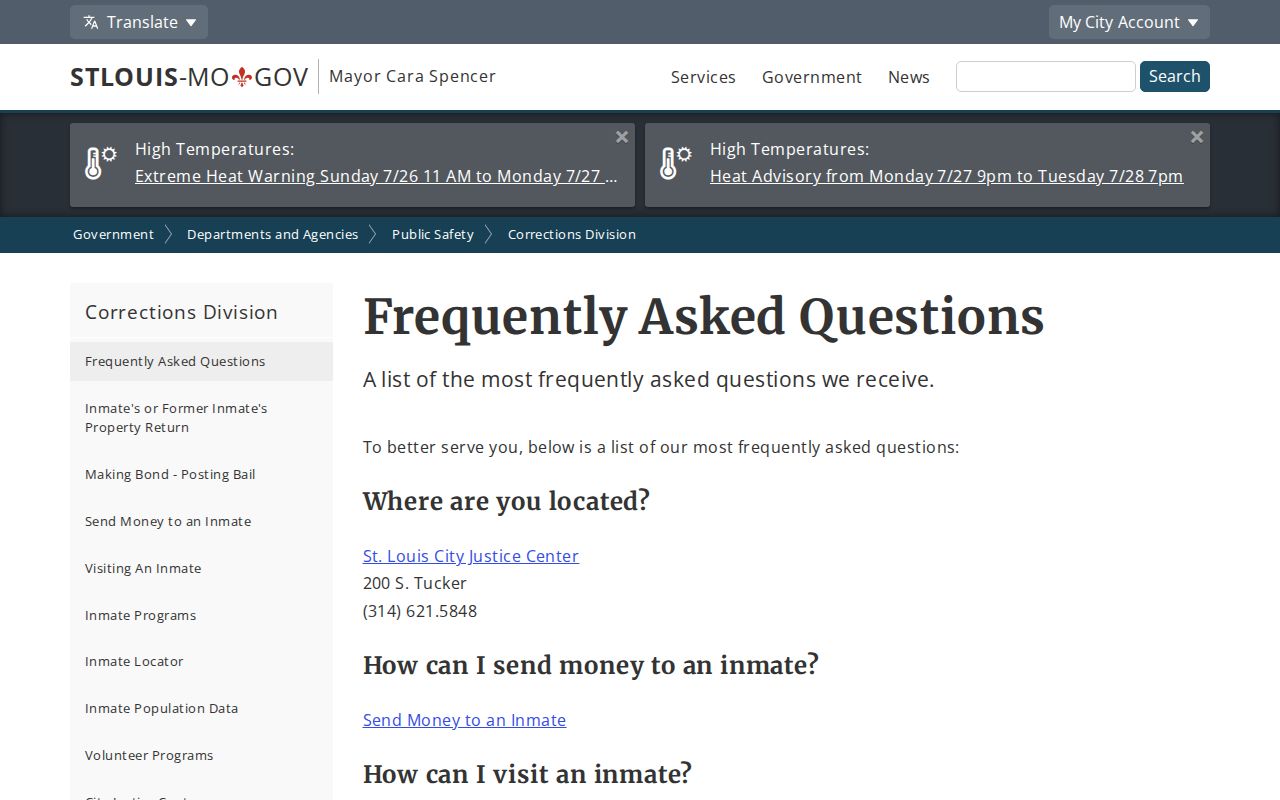
The official FAQ and Corrections contacts page publish conflicting extensions. Do not guess which extension is current. Call the main Corrections number at (314) 621-5848, say that the person has already been released by the Division, and ask for the current Data Entry route. Provide the full booked name, approximate confinement dates, year of birth if needed to distinguish the person, and master number if known. For someone still confined, Corrections directs the inquiry to the person’s correctional caseworker instead.
Request St. Louis City Release Records
When the letter does not answer the question, use the City’s official Sunshine request channel and identify the Department of Public Safety, Division of Corrections. Missouri Chapter 610 works best when the request names an existing record rather than asking the custodian to investigate or write a new history.
- Identify the full booked name, an approximate date range, year of birth when needed, and booking or master number when known.
- Request admission and release date and time, release type or coded disposition with its definition, release authority, releasing facility, destination or receiving agency, and holds shown at departure.
- Ask for the associated booking photograph as a separate electronic item only if it is needed.
- Request the open, segregable portions and the specific legal basis for each redaction or withholding.
- Ask for electronic delivery and an advance estimate if expected fees exceed a stated limit.
RSMo 610.026 permits reasonable search, research, and copying charges under statutory rules. The custodian must respond as soon as possible and no later than the end of the third business day by providing access or explaining the cause of delay and the earliest access time. That deadline governs the response, not guaranteed completion of a complex request. Do not apply the City medical-record page’s special fee figures to an ordinary release record.
Note: Ask for a cost estimate because St. Louis City publishes no flat fee for an ordinary release transaction.
St. Louis City Record Retention
Missouri Sunshine Law starts from openness but contains specific closures and exceptions. RSMo 610.023 establishes public-body custodian duties, 610.024 requires separation of open material from closed material when feasible, and 610.026 governs access mechanics and fees. Juvenile, victim, medical, security, investigative, sealed, and expunged information can be withheld or redacted.
RSMo 610.140 governs petitions to expunge qualifying arrest, plea, trial, or conviction records, with exclusions and waiting rules. Section 610.100 addresses arrest records that become closed under specified circumstances. A closed or expunged result can reduce what appears in Case.net or what an agency releases. It does not prove that no custody occurred, nor does expungement necessarily erase every legally retained record. Eligibility questions belong with current court instructions, the clerk, or qualified legal help.
St. Louis City Bond Release Timing
St. Louis City’s bond process changes with the detainee’s location and time in custody. The official bond page separates people still in police custody, people at CJC for less than 24 hours, and people confined longer. It also warns that several hours can pass after payment before release processing finishes. Therefore, a receipt shows that bond was posted, not that the person has walked out.
For a same-day status, call the correct bond or CJC contact and ask whether physical release is complete. Then compare the jail timestamp with the court docket. Other warrants, detainers, identity questions, transport needs, or administrative steps can delay departure after a judge authorizes release. The reverse timing problem is also possible: the person may leave before an online court entry appears.
St. Louis City Property After Release
Property return is a separate post-release task, not part of obtaining a release record. St. Louis City maintains a former-inmate property-return service and a dedicated CJC Property Unit. The Corrections contacts page lists the main number, (314) 621-5848, with property extensions 2233 and 2270. Because service URLs and contact routing can change, start from the current Corrections service page or main number.
A property inquiry should identify the former detainee and booking episode, then ask what pickup authorization, identification, timing, or alternate recipient procedure applies. The existence of unclaimed property does not independently prove a release type or date. Use Data Entry or a Sunshine request for release proof and the Property Unit for belongings.
Note: Resolve the current Property Unit extension through the main Corrections number before arranging a pickup or traveling to CJC.
Search St. Louis City Releases
There is no verified official 24-hour, 48-hour, or 72-hour City release feed. The population dashboard measures current and historical population, not named departures. A released-person search should move through the sources in an order that matches the possible custody path.
- Use the official City locator with the exact first and last name. Record when the search was run.
- If there is no match, consider exact-name mismatch and police-floor or substation custody before assuming release.
- For a known former CJC detainee, call Corrections for the Data Entry letter route or request the release transaction.
- Search Case.net for the City of St. Louis or Twenty-Second Judicial Circuit case, including bond, disposition, judgment, sentence, warrants, and later entries.
- If the docket shows commitment to Missouri DOC, search the state system. Transfer from CJC to DOC is not release to the community.
- Check current MOVANS when a notification was registered. Confirm any notice with the responsible jail, DOC office, or court.
- Use BOP for a federal sentence and ICE ODLS for possible current immigration detention.
The official City inmate-locator page explicitly lists release as only one reason a person may not appear.
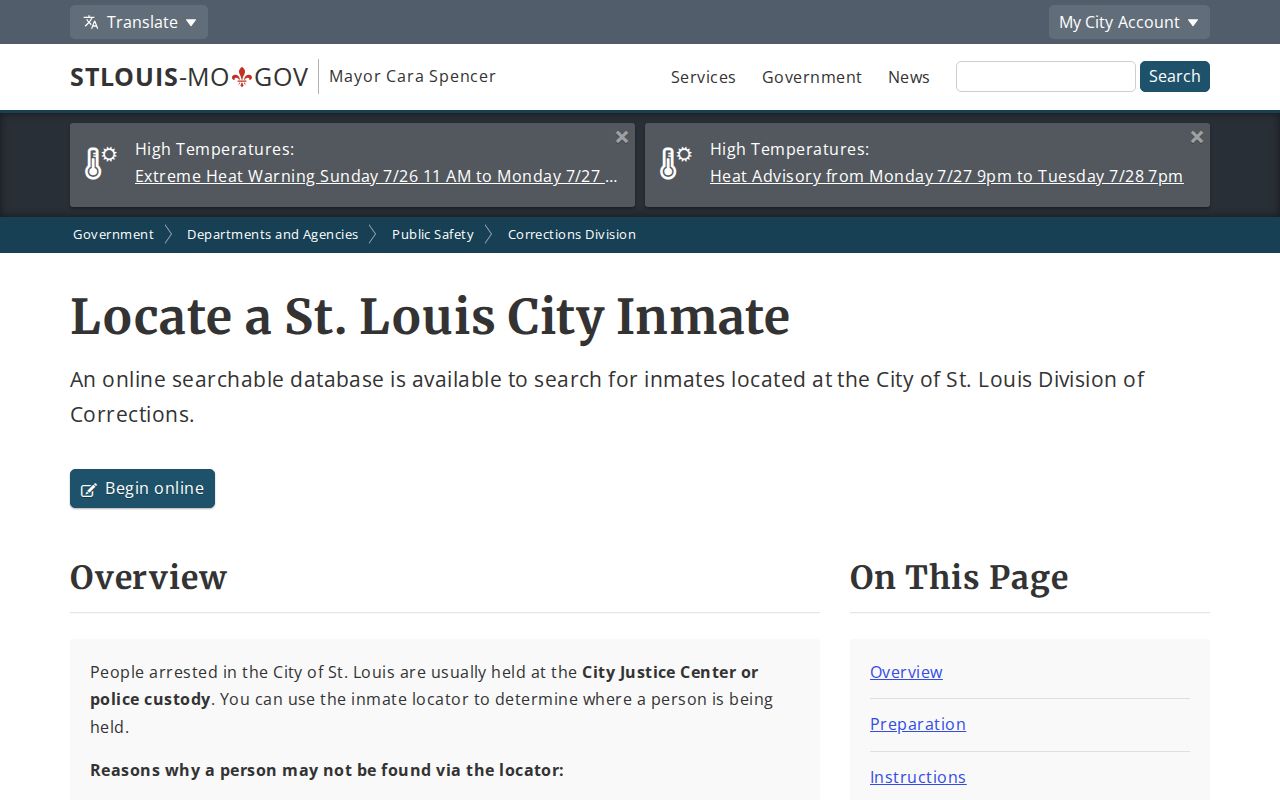
The locator is a test of current City Corrections custody, not an archive. Its advertised result fields are name, year of birth, race, sex, and facility. It does not promise a release date, release reason, booking photo, or recent-release tab. For a months-old or years-old question, begin with Case.net, the Data Entry letter or Sunshine request, and Missouri DOC when a state sentence appears.
Missouri DOC Search for City Releases
Missouri DOC covers people under active state incarceration or supervision, including probationers and parolees. It does not cover an ordinary CJC bond release, and its individual search expressly excludes discharged offenders. Search by DOC number when available, or by first and last name. The official screen says aliases are included.
The Missouri DOC Offender Search is the appropriate next step only when the City case led to DOC custody or supervision.
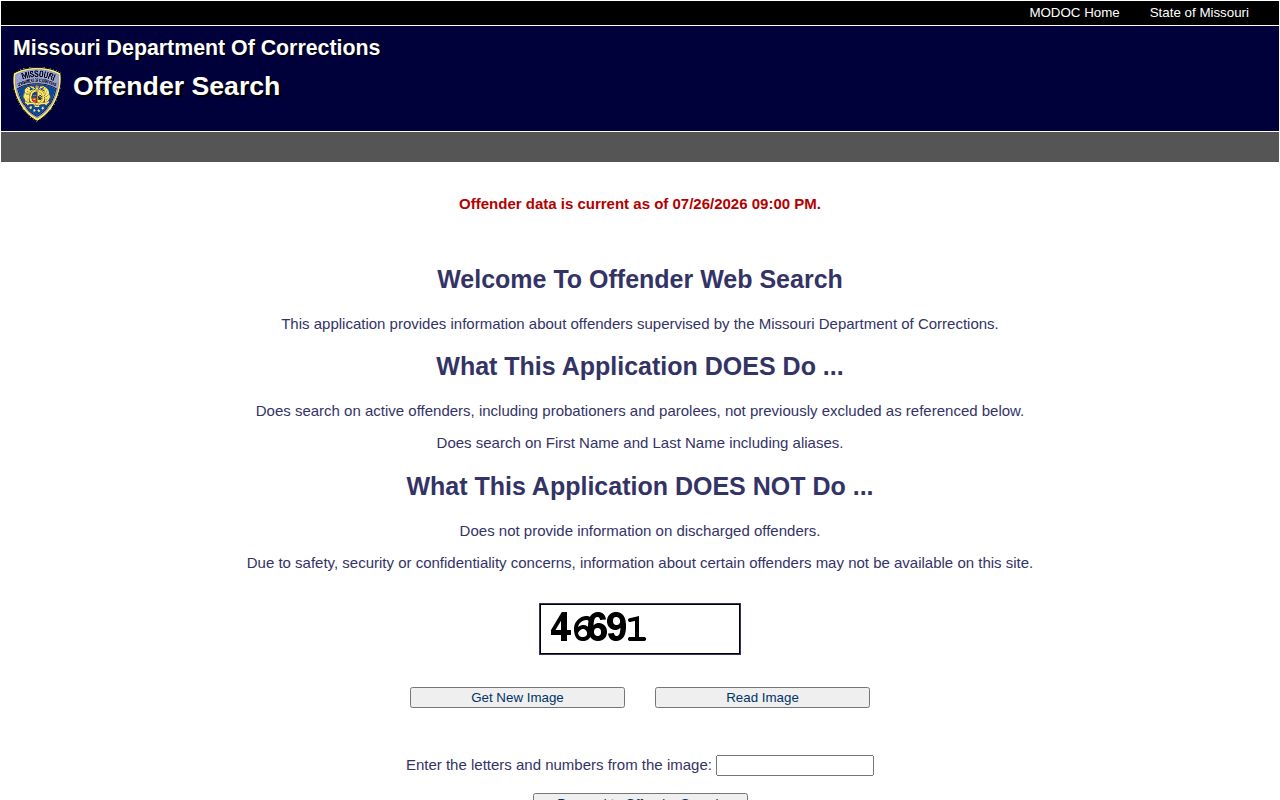
Open the individual result and reconcile it with the St. Louis City court case. A field-office assignment can indicate supervision in the community rather than prison confinement. A no-result can mean the person is discharged, outside DOC jurisdiction, or not found with the entered identifiers.
| Search or result field | How to use it |
|---|---|
| DOC number | Best identifier when known; reduces name collisions. |
| Name and aliases | Use supported spellings and compare other identifiers before accepting a match. |
| Cause number and sentence county | Match the result to the St. Louis City Case.net matter. |
| Assigned location | Distinguish an institution from a probation or parole field assignment. |
| Status and as-of time | Read the status in its time context; do not convert parole or conditional release into discharge. |
| Minimum and maximum dates | Historical-file sentence calculations, not guaranteed physical departure appointments. |
DOC’s nightly historical file distinguishes Sentence-I Minimum Release Date, Sentence Maximum Release Date, sentence structure, and a completed flag. It can contain records reaching back as early as 1974, but DOC warns that the data may be incomplete or not current. For an exact status question, provide Offender Inquiry with the full name, DOC number, date of birth, and a narrow question; a responsible institution caseworker or probation/parole field officer is the proper source for case-specific status.
Note: A discharged person may be absent from the live Missouri DOC search even when a historical record still exists.
St. Louis City Release Supervision
A CJC bond release does not itself place someone on parole or probation. Likewise, a dismissed City charge does not create supervision. When Missouri DOC does have jurisdiction, compare the offender search’s status and assigned field location with the court cause number. An active field assignment generally points to community supervision. Verify whether a case is active, completed, revoked, or transferred through the assigned field office and the docket.
A parole hearing is not a release. The Missouri Parole Board can set another hearing or a future release date, and DOC says a decision normally takes about eight to twelve weeks after a hearing. Even a future date can remain subject to conditions or other legal barriers. Missouri’s 85-percent minimum-prison-term rule applies to defined dangerous felonies under RSMo 558.019, not to every Missouri prisoner.
St. Louis City Release Court Records
Beginning January 2, 2025, St. Louis City municipal cases moved into Missouri Case.net, and the former municipal search and payment systems stopped serving pending cases. Researchers now use the same statewide portal for municipal and state criminal matters but still must identify the correct jurisdiction and case type. Select the City of St. Louis municipal matter or the Twenty-Second Judicial Circuit case rather than a case from the separate St. Louis County courts.
Inspect charges, bond entries, warrants, docket text, disposition, judgment, sentence, and later activity. A docket may not show the Corrections master number, so reconcile the record using name, public birth information, incident date, charge, and cause number. A release order supplies legal authority, while the Corrections transaction supplies the physical departure timestamp. Older municipal records affected by the migration may require the Municipal Court clerk.
MOVANS for St. Louis City Releases
Missouri Automated Victim Notification System, or MOVANS, is a status and notification channel rather than a substitute for the jail, court, or DOC record. On May 5, 2026, Missouri replaced the third-party VINELink delivery platform. Current public notifications use SMS text or email; the former voice-call and VINELink-app workflow ended.
In the current portal, custody, court, and protection-order registrations are separate. Search a specific person, compare displayed identifiers, open the relevant record, and choose the offered custody events. Text registrants should preserve the four-digit PIN used to manage or verify registration. Local jail and court questions route through MOVANS, while Missouri DOC notification changes go through DOC Office of Victim Services. Some jails may not be online, and a disappeared result is not proof of release. Confirm a release notice with CJC Data Entry, DOC, or the court.
Federal Paths After City Release
The BOP locator covers federal prisoners from 1982 to the present. Search by Register Number or by name with age, race, and sex. A former federal prisoner result normally supplies a release date and indicates that BOP custody ended. It does not establish that state, local, immigration, or another custody has ended, and it does not prove that federal supervision is complete.
Federal pretrial custody is managed by the U.S. Marshals Service and may occur in a contract facility. There is no general public USMS released-inmates list, so use the federal court docket and actual detention facility before BOP designation. ICE’s Online Detainee Locator supports an A-number plus country-of-birth search or biographical search, but it concerns current ICE detention rather than historical releases. A CJC transfer to ICE ends City custody without establishing community release. Request the receiving authority from the City record, then check ICE. CJC is not documented as an ICE contract jail.
Note: A federal or immigration locator answers only for its own custody system and cannot confirm every other possible hold.
St. Louis City Release Sources
| Situation | Primary source | Critical limit |
|---|---|---|
| Currently listed at CJC | St. Louis City locator | A current-custody tool, not a release archive |
| Former CJC detainee | Data Entry letter, release transaction, Case.net | No City recent-release feed is verified |
| Police-only arrestee | SLMPD custody record and court case | Corrections cannot issue the City incarceration letter |
| State prisoner or supervisee | Missouri DOC and Case.net | Parole or conditional release is not discharge |
| Released federal prisoner | BOP locator and federal docket | BOP release does not rule out other custody |
| Possible ICE detainee | ICE ODLS and receiving-agency information | ODLS is not a historical release archive |
For current City custody, search exact first and last name. For durable proof after release, ask for the City record that documents the event. When a sentence, warrant, or detainer crosses systems, follow the destination rather than treating the absence of one record as the end of custody.
Workhouse Release Records Are Historical
Medium Security Institution, widely known as the Workhouse or MSI, is a prominent but obsolete search result. The City says MSI has held no detainees since June 2022 and will not house detainees again. Demolition began in March 2025. It must not be treated as a present jail, current release source, or place to call for someone now in custody.
For confinement before closure, request historical City Corrections records and review the court docket. A Sunshine request should name MSI, the person, the approximate date range, and the precise admission and release fields sought. CJC/Data Entry is the sensible starting contact because the same Division operated both facilities. Today, the active local facility is the St. Louis City Justice Center.
Justice Center Release Records
CJC is located at 200 South Tucker Boulevard, St. Louis, Missouri 63102. The facility operates continuously, while Corrections administrative contact hours are Monday through Friday, 8:00 a.m. to 5:00 p.m. The general number is (314) 621-5848. The official facility description says CJC opened in 2002, has six stories, and has a stated capacity of 860.
The current lookup uses exact first and last name. The released-person path is Data Entry’s Letter of Incarceration or a release-transaction request, paired with Case.net and then Missouri DOC or federal sources when the destination requires it. Always ask for release type and destination because leaving CJC can mean either return to the community or transfer to another custodian.
Note: The Division of Corrections, not the St. Louis City Sheriff, operates the City Justice Center.